
For NICU Awareness Month, a Pensacola team is building brain development, connection, and community one book at a time.
read time: 5 minutes
September is NICU Awareness Month. It is a time to recognize the babies whose first bedrooms are filled with monitors and medical equipment, the professionals caring for them, and the families learning to parent in circumstances they never expected.
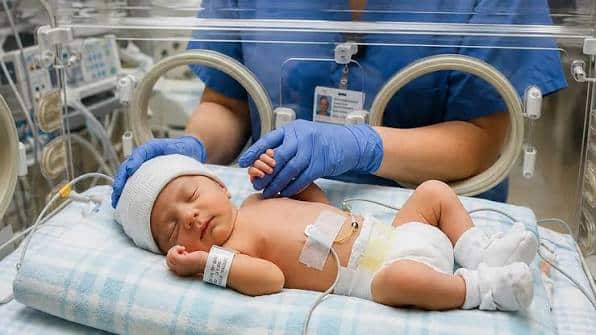
Most parents imagine meeting their baby and pulling them close. A NICU parent may instead meet their child through the wall of an isolette — surrounded by alarms, unfamiliar language, tubes, wires, and questions no new parent expects to ask:
- Is my baby in pain?
- Can I touch them?
- What does that number mean?
- When can I hold them?
- What happens next?
In this setting, supporting the baby and supporting the parent are not competing priorities. They are part of the same work.
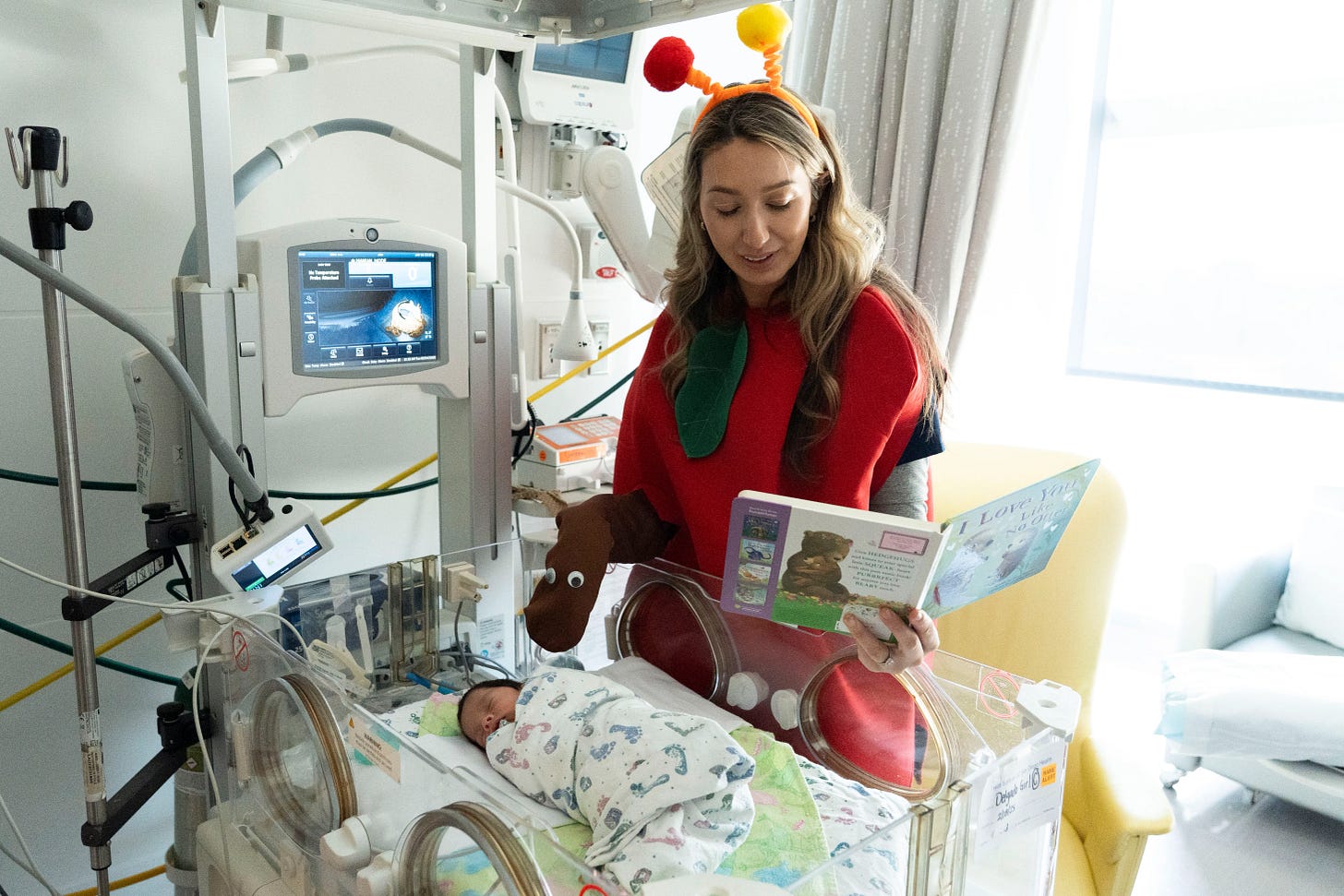
That’s the heartbeat behind a new local effort at the Studer Family Children’s Hospital at Ascension Sacred Heart in Pensacola. Under the leadership of Julie Adams, Patient Care Manager for the Level 3 NICU, the team is launching twice-monthly parent classes centered on using books to bond and engage with babies in the hospital.
Along with Hannah Godfrey, BSN, RN, Assistant Manager, and Paige Marcin, Director of Building Brains in Pensacola, this team is tackling a bigger goal: creating a real community among families on the NICU floor through shared experiences and shared life.

Julie Adams
Patient Care Manager, Level 3 NICU

Hannah Godfrey, BSN, RN
Assistant Manager, Level 3 NICU
The classes will not simply show parents how to read to a baby who may be sleeping, medically fragile, or unable to respond in familiar ways. They will explain why the sound of a parent’s voice, a familiar ritual, and a few minutes of focused connection can matter for the baby’s developing brain and for the parent who may feel frightened, helpless, or disconnected from the role they expected to have.
The NICU is caring for more than one patient
A NICU admission isn’t just a medical event for a newborn; it can be a profound psychological crisis for the entire family.
Research paints a clear picture of this hidden weight. A systematic review of over 6,000 parents found that during the first month after birth, the prevalence of anxiety hovered around 42%, with 40% experiencing post-traumatic stress symptoms (Malouf et al., 2021). For some, those symptoms remained elevated more than a year later.
These numbers are not evidence that NICU parents are failing to cope. They are evidence that the experience can be genuinely traumatic.
Parents are recovering from difficult births while commuting back and forth to the hospital. They feel afraid to touch an impossibly small baby, scan monitors for danger, and battle a crushing sense of guilt whenever they leave the bedside. Mothers, fathers, partners, grandparents, guardians, and siblings can all be affected — even though research has historically focused most heavily on mothers.
The encouraging news? Support works.
A landmark 2026 systematic review and meta-analysis in JAMA Pediatrics examined 160 studies involving over 16,600 NICU parents. It confirmed that bonding interventions, family-centered care, education, and emotional support directly reduce parental anxiety, stress, and depression (Niehaus Milligan et al., 2026).
A reading class can’t replace medical treatment or trauma-informed care when a parent needs it. But it can be an accessible anchor—an invitation to participate, connect, and finally feel like a parent rather than a visitor at the bedside.
Reading gives a parent something meaningful to do
One of the quiet injuries of the NICU experience is the loss of the ordinary.
You imagined feeding, rocking, dressing, and bathing your baby. In the NICU, those tasks are initially managed by machines and specialists, or they have to wait. Even the most loving parents eventually ask: What is my role here?
A book offers an answer.
For a few minutes, you don’t have to interpret a monitor or master medical jargon. You can take a breath, sit near your baby, and offer something deeply familiar: your voice.
NICU parent guides heavily reinforce this. They encourage families — when medically appropriate and in coordination with the care team — to talk, sing, read, provide gentle touch, participate in care, and create familiar routines. Your baby doesn’t need theatrical character voices or a “perfect” book. You can read a picture book, a poem, a prayer, a family story, or even the same three pages over and over again. The power is in the predictable presence: I am here. You know my voice. We are doing this together.
What reading does for a baby in the NICU
While every baby’s sensory tolerance is unique, the growing body of research on parent-led reading in the NICU is remarkable:
- More Meaningful Language Exposure: In a randomized trial, babies in a maternal reading intervention experienced nearly twice as many conversational turns by 36 weeks postmenstrual age compared to standard care (Mayne et al., 2022). A follow-up study linked this early language growth to stronger language performance at age two (McGowan et al., 2024).Babies born very early may spend weeks or months in an auditory environment dominated by equipment, alarms, and adult conversation that is not directed toward them. Parent-led reading creates purposeful speech and, eventually, the beginnings of conversational rhythm.
- Brain Development: Brain imaging near term-equivalent age has shown more mature structure in language-processing pathways among preterm infants who regularly heard recorded maternal speech (Travis et al., 2025). That is evidence about a specific, carefully delivered recording intervention—not proof that any single story rewires a baby’s brain—but it helps explain why researchers are paying close attention to a parent’s voice in the NICU (Travis et al., 2025).These findings do not mean that a parent must fill every bedside minute with words. Rest is essential, and every baby’s sensory tolerance is different. They do suggest that warm, developmentally appropriate language from a parent can become part of the baby’s care environment.
- Physiologic Stability: Smaller studies have observed that some preterm infants show lower heart rates and fewer drops in oxygen saturation during or shortly after live bedside reading by a mother’s voice (Scala et al., 2018; Rand & Lahav, 2014).These studies are small, and they do not mean reading is appropriate at every moment. The bedside nurse can help parents notice stress cues and choose the right volume, distance, timing, and duration for their baby.
- Long-Term Language Protection: In a study of 100 families, parents of preterm infants who received a picture book upon entering the NICU and were encouraged to read showed a smaller decline in standardized hearing-and-language scores between 9 and 18 months compared to control groups. Researchers concluded that early NICU reading is a feasible, powerful way to support both language development and the parent-infant bond over the first two years of life (Neri et al., 2021).
The book is the vehicle. Relationship is the destination.
What reading does for the parent
Reading creates a small pocket of agency in a place where parents often feel entirely powerless.
It gives your attention somewhere to land besides the flashing monitor. It slows the frantic pace of the room. In a 2025 study of caregivers participating in bedside reading programs, reported anxiety dropped and maternal attachment scores increased (Henry et al., 2025).
You may have seen broad claims that six minutes of reading lowers cortisol or reduces stress by a precise percentage. The NICU-specific evidence is more careful. It supports lower reported anxiety, stronger attachment, richer language exposure, and signs of infant physiologic regulation. However, direct evidence that a short bedside reading session lowers cortisol is not yet established.
That distinction does not make the ritual less valuable. It makes the reason for offering it more trustworthy.

You may have seen broad claims that six minutes of reading lowers cortisol or reduces stress by a precise percentage. The NICU-specific evidence is more careful. It supports lower reported anxiety, stronger attachment, richer language exposure, and signs of infant physiologic regulation. However, direct evidence that a short bedside reading session lowers cortisol is not yet established.
That distinction does not make the ritual less valuable. It makes the reason for offering it more trustworthy.
Community is part of the intervention
The classes planned at Ascension Sacred Heart offer something a handout never could: other people.
NICU life can be profoundly isolating. Friends don’t always know what to say, and family members offer reassurances that miss the depth of the fear. A recurring class creates a reason to gather.
One parent shows another how to position a chair. Someone admits that reading aloud felt awkward at first. A father realizes he isn’t the only one who freezes when an alarm sounds. A family further along in the journey may offer hope without pretending the experience is easy.
This is what Julie Adams, Hannah Godfrey, and Paige Marcin are building: not forced sharing, but a welcoming space where common experiences turn into genuine connection.
This community-first model fits hand in hand with broader family-centered NICU standards. The March of Dimes highlights peer support and parent education as key to building confidence, while the Maternal Mental Health Leadership Alliance points families toward specialized coordinators, father support, and national networks.
Sometimes the most therapeutic sentence is not advice. It is: Me too. I remember that. You are not alone.
How to Support a NICU Family (Or Yourself)
If you love a NICU parent, skip the generic questions:
- Ask: “How are you sleeping?” or “Can I sit with you without making you talk?” rather than asking only about the baby’s health
- Keep showing up after discharge. Trauma doesn’t end the day the monitors are unplugged.
Please remember: asking for support isn’t taking attention away from your baby, it’s protecting the heart of your family. If fear, panic, guilt, or sleeplessness are making it hard to function, talk to your NICU nurse, social worker, doctor, or therapist. You don’t have to carry this alone.
- The Maternal Mental Health Leadership Alliance maintains a collection of NICU-specific resources.
- Hand to Hold offers free virtual peer-support groups, and its free virtual counseling program is available to eligible NICU families in Florida and Texas.
If you or someone you know is in immediate danger or having thoughts of self-harm, call emergency services or call or text 988 in the United States.
A book cannot change why a baby is in the NICU, but it can change a moment
It can turn a bedside into a shared space.
It can give a parent a role when everything feels uncertain.
It can surround a developing brain with the rhythm and pattern of loving language.
It can open a conversation between two families who thought they were alone.
During NICU Awareness Month, we rightly honor life-saving medicine. But let’s also honor the small, human practices that help a family become a family under extraordinary circumstances—starting with four simple words:
“Let’s read this together.”
Keep Building Connection and Brain Development
If you are looking for more ways to support early childhood development, foster strong connections, and bring science-backed moments into your everyday routines, we are here to help:
- Build a Brain — Explore our clinical consulting, community resources, and professional initiatives dedicated to early brain development in pre- and perinatal settings.
- BabyBrain.ai — Discover our new platform delivering personalized, science-backed developmental guidance right to your fingertips from pregnancy through age three.
What about you? Have you or someone you know navigated a NICU journey? What small rituals helped you feel connected during the hardest days? Drop a comment in our community platform to share your story or support another parent reading this.
References:
Henry, A., et al. (2025). Bedside reading programs in the NICU: Evaluating parental anxiety and maternal attachment scores.
Malouf, R., et al. (2021). Prevalence of anxiety and post-traumatic stress symptoms among parents of infants admitted to the neonatal intensive care unit: A systematic review. Journal of Clinical Nursing, 30(13-14), 1805–1818.
Mayne, S., et al. (2022). Effect of a maternal reading intervention on conversational turns in preterm infants: A randomized controlled trial. Pediatrics, 150(4), e2022056781.
McGowan, J., et al. (2024). Long-term language outcomes following a NICU-based language and reading intervention through age two. Early Childhood Research Quarterly, 68, 112–120.
Neri, E., et al. (2021). Early reading promotion in the NICU: Feasibility and impact on developmental outcomes and the parent-infant relationship. Journal of Developmental & Behavioral Pediatrics, 42(5), 380–387.
Niehaus Milligan, A., et al. (2026). Interventions to reduce anxiety, stress, and depression in NICU parents: A systematic review and meta-analysis. JAMA Pediatrics.
Rand, K., & Lahav, A. (2014). Maternal sounds elicit lower heart rate in preterm infants in the neonatal intensive care unit. Acta Paediatrica, 103(6), 633–640.
Scala, M., et al. (2018). Physiological stability in preterm infants during bedside maternal reading. Journal of Neonatal Nursing, 24(3), 145–149.
Travis, K. E., et al. (2025). Alterations in language-processing brain pathways in preterm infants exposed to recorded maternal speech: A randomized trial. NeuroImage: Clinical, 45, 103720.