
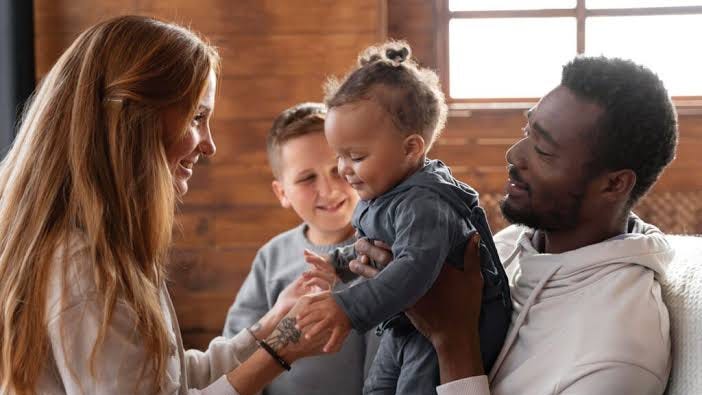
Kids need people who keep showing up. So do parents.
When a child is welcomed into a new family, trust doesn’t come with the paperwork. It grows slowly, through shared meals, bedtime stories, and the everyday moments when an adult notices what a child needs and responds.
Think about your toddler melting down because you gave them the blue plate instead of the green one. Dinner is half-made. You’re exhausted. And somehow, this tiny disagreement has become the biggest thing happening in your house.
You take a breath. You lower your voice. Maybe you sing the same song you’ve sung a hundred times. Maybe you lose your patience and come back afterward to reconnect.
Those moments matter. As we explored in Your Voice Is Enough, a familiar, reassuring voice can help a child’s nervous system settle. And when we repair after a hard moment, we teach children something equally important: relationships can have difficult moments, and we can find our way back to each other. Trust grows through consistent care, not perfect parenting.
After attending a recent impact luncheon where Children’s Home Society of Florida highlighted the incredible work they’re doing in our community, I knew I wanted to learn more. So for National Adoption Month, I sat down with Leah Harrison, CHS’s Executive Director, to talk about what happens before, during, and long after a child joins a permanent family. I didn’t realize how much of our conversation would apply to every parent.
In this article, I’m sharing what Leah taught me, five small ways to build trust with your child, and how we can all help families feel supported.
What Leah taught me about adoption and belonging
I was expecting Leah to start by telling me all of the ways adoption can benefit a child. Instead, she led with a different perspective. She explained that CHS first works to help children remain safely with their birth families whenever possible. Sometimes that means connecting parents with transportation, household supplies, or services they wouldn’t otherwise be able to access.
Financial hardship doesn’t mean a parent loves their child any less.
When a child can’t safely go home, adoption gives them a permanent family. In the four Florida counties Leah’s team serves, 214 children were waiting to be formally matched with adoptive families when we spoke. Children are waiting in communities everywhere.
Becoming an adoptive parent starts with a conversation. Leah described the path her team walks families through: parent training, then further preparation and assessment, including a home study and background checks.
“We hold your hand through the process.” — Leah Harrison
Something that stuck with me was the way she talked about a child’s full story. A child can love their adoptive family and still miss siblings or grandparents. Those feelings may fluctuate as they grow. Her advice to families:
“Include them in the process from the start.” — Leah Harrison
When siblings can’t live together, CHS’s team arranges visits at least monthly, at a park, over a meal, wherever the kids can just be together.
That’s belonging. There’s no need to erase a child’s past; you can make room for all of it.
The 5 small habits that work for every child
These are the kinds of everyday moments that help a child new to a family learn to trust. None of them require turning playtime into a lesson, and you’re probably already doing them without realizing.
Make routines predictable. Use the same few steps before leaving the house, getting ready for bed, or preparing a meal. “First pajamas, then a story, then bed.” When your little one knows what to expect, there’s less to figure out and less to fuss about.
Offer comfort without demanding closeness. Some kids want a hug. Others need a little space with you nearby. Stay available, watch their cues, and let connection grow at their pace. For a child new to a family, hugs may need to wait until trust is there.
Build calm before you build limits. When feelings run high, settle the room first. Lower your voice, slow down, use few words: “You wanted to keep playing. I’m here to help.” Keep the safety limit, and lose the lecture.
Follow their lead in play. They roll a car, you roll one beside them. They babble at you, you answer and pause. These tiny back-and-forths are how babies practice connection.
Get curious about the hard moments. Tired? Overwhelmed? Missing someone? You don’t need the whole explanation to respond calmly. And if sleep, feeding, or behavior worries stick around, bring them to your pediatrician.
Why small moments matter so much
Babies and toddlers learn trust through repetition: someone notices they’re hungry, answers when they cry, follows their interest in a toy, and comes back when they need help. For children who have experienced disruption, foster care, or a move to a new family, those repeated experiences matter even more.
Can parents actually learn to build these connections?
Yes. Researchers have studied programs that help caregivers become more responsive to children’s needs.
One example is Attachment and Biobehavioral Catch-up (ABC), a program that coaches caregivers to follow children’s cues, respond with nurturing care, and avoid taking over interactions.
Stronger attachment. In a randomized trial of 120 children, about 12 to 32 months old, whose families were involved with Child Protective Services, 52% of children in ABC showed secure attachment, compared with 33% in the comparison group.¹
Lasting changes in parents. A 2024 study of 454 parents found that those in ABC were more sensitive and warm right after the program, and less intrusive. That drop in intrusiveness was still there two years later.²
Calmer stress systems. An earlier study of infants and toddlers in foster care found that children in ABC had lower levels of cortisol, a stress hormone, at the start of a lab assessment than children in a comparison program. Their cortisol changed similarly during the assessment.³
What does “intrusive” mean? Taking over an interaction, like repeatedly redirecting a toddler’s play toward what you want instead of following what they’re interested in. All of us do this sometimes. The goal isn’t perfection. It’s noticing and following their lead more often.
The American Academy of Pediatrics emphasizes safe, stable, nurturing relationships as central to supporting children who have experienced adversity.⁴
These studies looked at one specific program, not every family’s experience, and they don’t predict any individual child’s future. But the takeaway is hopeful: responsive parenting is a skill, and skills can be learned.
You can help build the village
Adoption day isn’t the finish line. Families may need help with records, a therapist, or guidance years later when grief or identity questions come up. The best adoption agencies keep supporting families long after the paperwork. Leah’s team at CHS, for example, offers post-adoption support through age 18.
And you don’t have to adopt to show up for a family. A few ideas:
Drop off a meal on a specific night (not “let me know if you need anything”)
Offer a ride to an appointment
Respect boundaries around visits, photos, and personal questions
Check in after the first few weeks, when everyone else has gone quiet
The same goes for any new parent in your life. Make the connection before they urgently need it.
A reminder for parents
Children don’t need us to get every moment right.
They need to know that when things get hard, we’re still here. That we’ll listen, reconnect, offer comfort, and keep learning alongside them.
And parents need people who do the same.
So this week, choose one small way to show up for your child. Or show up for another parent who might need a little support.
Because belonging isn’t built in a day. It’s built in the moments when we keep coming back.
What’s one little thing you do that helps your child feel safe and connected? I’d love to hear about it in the comments.
Want help building a routine? Ask Buddy, our AI Parent Companion at The Build a Brain Project: “Help me create a simple, predictable bedtime routine for my toddler.” Buddy offers educational support, not medical or mental health advice.
Want help building a routine? Ask Buddy, our AI Parent Companion at The Build a Brain Project: “Help me create a simple, predictable bedtime routine for my toddler.” Buddy offers educational support, not medical or mental health advice.BuddyWatch my full conversation with Leah on The Critical Window, coming November 10th. We talk about supporting families before adoption, what preparation looks like, keeping siblings connected, and what families need after adoption day.
Curious about adoption? Start here
Start by asking questions. It doesn’t commit you to anything. Reach out to a licensed adoption agency or your local child welfare agency and ask about the children waiting, the training involved, and the support available.
In the U.S., AdoptUSKids shares information about children in foster care who are waiting for families, plus resources by state.
Expecting and weighing your options? Your prenatal provider can connect you with options counseling, support if you choose to parent, or an adoption professional.
Want support early? Programs like Florida Healthy Start (prenatal care coordination) and Healthy Families (in-home parenting support) connect with parents during pregnancy, so families know where to turn long before the baby arrives.
Already an adoptive family? Ask your agency about post-adoption services like counseling, community resources, and help keeping sibling connections.
If you’re in Northwest Florida
Visit the Greater Pensacola services page.
Call 850-266-2700 and ask for adoption information or post-adoption support.
Ask about Quality Parent Training, preparation, and the next steps appropriate to your situation.
Leah also shared Quality Parent Training flyers from NWF Health Network. The schedules offer both virtual and in-person sessions.
Escambia & Santa Rosa Counties: Starts Jan 5–Feb 16 (Tuesdays, 6–9 p.m.). Contact Stephanie Case (850-728-2570 | Stephanie.Case@NWFHealth.org).
Okaloosa & Walton Counties: Contact Michael Rogers (850-739-9630 | Michael.Rogers@NWFHealth.org) for upcoming series.
Confirm dates, locations, openings, and participation requirements with the coordinator before making plans. The flyers invite families to reach out if the listed options do not work for them.
Outside Florida? Ask your prenatal provider about home visiting programs near you.
Resources
Bernard, K., et al. (2012). Enhancing attachment organization among maltreated children: Results of a randomized clinical trial. Child Development, 83(2), 623–636.
Labella, M. H., et al. (2024). Is Attachment and Biobehavioral Catch-up effective for parents with insecure attachment states of mind? Child Development, 95(2), 648–655.
Dozier, M., et al. (2008). Effects of an attachment-based intervention on the cortisol production of infants and toddlers in foster care. Development and Psychopathology, 20(3), 845–859.
Duffee, J., et al. (2021). Trauma-Informed Care in Child Health Systems. Pediatrics, 148(2), e2021052579.
Additional resource: AdoptUSKids (2026), Celebrating National Adoption Month.