
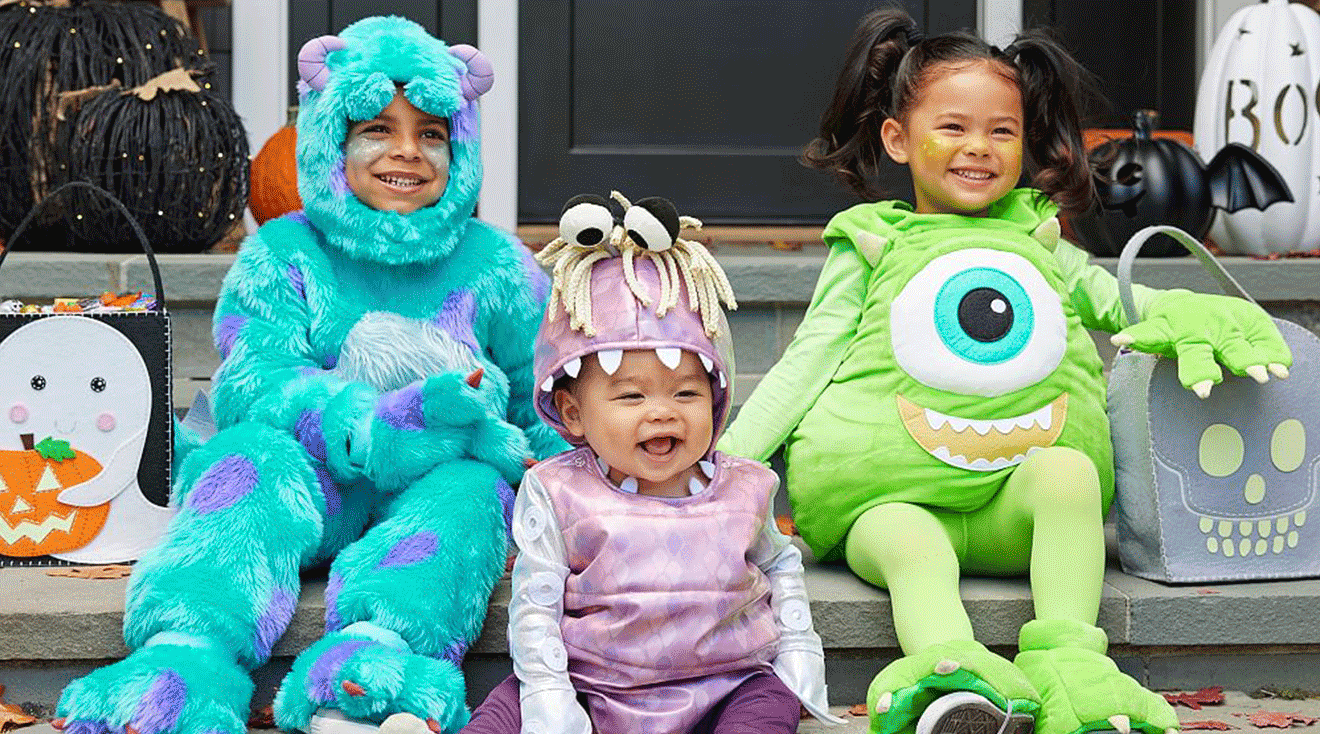
The preschool costume parade is Wednesday. The fall festival is Friday. There’s a neighborhood gathering on Saturday, and someone has already asked what time you’re going trick-or-treating.
Meanwhile, your toddler skipped a nap, the costume is “scratchy,” and you are still figuring out dinner.
Halloween can be joyful. It can also ask a lot of a tired little one, and of the grown-ups caring for them. So before adding one more thing to the calendar, ask: What would make this week feel good for our family?
Short on time? Jump to the Halloween game plan at the bottom.
Start with the toddler you have today
Last year they loved the pumpkin patch. This year they won’t walk past the inflatable ghost. They talked about their costume all week, and now they won’t put it on.
That’s normal. As toddlers’ memory and imagination grow, new fears can show up [1]. Masks change familiar faces, and the line between real and pretend is still fuzzy. Knowing something is “just pretend” doesn’t automatically make it feel okay.
Try: “That pumpkin made a loud sound. You can stay beside me. We can look from here.”
You don’t need them to touch it, walk up to it, or pose next to it. As pediatrician Dina DiMaggio, MD, FAAP, puts it:
“If your little one doesn’t want to participate in Halloween, then let that be OK.”
Animal ears with their favorite shirt, or regular clothes, can be today’s costume.
Leave room for imagination—and curiosity
Our partners at ELCNWF recently tackled the spooky side of parenting on their podcast The Only Adult in the Room, in Episode 18, “Paranormal Parenting: Imaginary Friends, Monsters, and Zombies, Oh My!” [7] [Listen here.] The hosts remember an imaginary guardian named George and a giant pink dragon. Their take: get curious about pretend play before deciding it’s a problem. A make-believe companion and a frightening Halloween experience don’t mean the same thing.
“Behavior has meaning,” the hosts remind listeners. At a festival, that is a prompt to look closer: Is the mask unsettling? Is the costume uncomfortable? Does your child need rest or closeness? You don’t have to guess perfectly. Notice, ask, and adjust.
Tired toddlers need a different plan
Sleep and big feelings are closely linked, even for little ones. In one small study, toddlers who missed a nap showed less joy and more frustration during puzzle tasks than when they were well rested [3]. A tired toddler at a festival isn’t being difficult. They’re running on empty.
Toddlers also can’t calm big feelings on their own yet. They need a grown-up to stay steady beside them (experts call this co-regulation) [4]. It includes warm, responsive interactions and an environment that makes coping more manageable.
At a festival, that might mean moving away from the speakers, sitting together, or leaving before everyone has finished their activities. Your child gets practice experiencing a difficult feeling with someone who notices and helps.
Before you go
Look at the whole week. An evening event feels very different after a quiet day than after a costume parade, a classroom party, and a short nap. Pick the outing you really want to do and leave breathing room around it. If you have older kids too, it’s okay to split up or choose different activities for different ages.
Practice the new parts. Show a photo of where you’re going, or describe it simply: “We’ll see pumpkins, walk with Grandma, then come home.” Try the costume on for a few minutes. Practice knocking on a door together. Offer small choices: “Hat or animal ears?” Participation can be gradual. Watching from your arms still counts as joining in.
Check what’s playing in the background. In the episode, one host shares how her almost-three-year-old picked up on The Walking Dead playing while the adults watched, and started pretending to cook food for zombies so they wouldn’t eat her. It’s one family’s story, but it’s a good nudge: what is your child seeing and hearing this week? Check the TV, autoplay videos, and older siblings’ picks, and ask big kids to skip the surprise scares.
Plan for the grown-ups, too. Decide who stays with the toddler, who handles older siblings, and who carries the bag. Pack water, a snack, and a change of clothes. Pick a leave time before you arrive, and give yourself permission to go sooner. It’s last week’s support plan in a new setting: Who can help, with what, and when?
While you’re there
Watch for “I’m done” signals. Clinging, turning away, covering ears, or repeatedly asking to be carried may be reasons to check in. Some children become quieter; others protest.
Try: “Do you want to watch from here, or take a break with me?”
A break can be a quieter bench, a familiar book, or a few minutes away from the busiest area with a trusted adult. You can decide afterward whether to return.
Use fewer words when feelings are big
Try: “That was loud. I’m here. Let’s go somewhere quieter.”
Offer closeness if your child wants it, and keep them safe if they are trying to run or hit.
If leaving brings tears, you can name the disappointment and still follow through:
Try: “You wanted another turn. It’s hard to leave. I’m going to help you get home.”
A child can be disappointed about leaving and still need the evening to end.
After the fun
Head back to the familiar. Pajamas, a favorite book, your usual bedtime routine. If you can, keep the last hour before bed calm and screen-free [5].
Talk about it later. Once everyone’s rested, look at a photo together: “You liked the little pumpkins. The big mask surprised you.” Let them answer with words, pointing, or play.
If the night was harder than expected, that’s not a failure. You learned something useful for next time.
When the spooky feeling comes home
Halloween fears can follow kids to bed. In the same episode, one host shares that removing a doll her kids found scary helped with bedtime battles. Again, it’s one family’s experience, but it’s worth asking what feels different before assuming your child is just refusing sleep.
Try: “Is there something in your room that feels scary tonight?”
Little ones may show you by pointing or playing. Acknowledge the feeling, then let them help pick a simple fix, like moving a decoration out of sight. If fears stick around, disrupt sleep or daily life, or raise safety concerns, check in with your child’s healthcare provider.
Be gentle with yourself, too
Maybe you left early. Maybe you never got the photo you pictured. Those feelings deserve kindness, too.
And if you raised your voice in a hard moment, you can always reconnect: “I was frustrated, and I shouted. I’m sorry. Let’s try again.”
Your Halloween game plan
Last week, in Before Baby Arrives, Make a Plan for You, Too, we talked about lining up support before exhaustion takes over. That idea still matters once babies become toddlers. If you filled out last week’s plan, pull it out - this one works the same way.
Answer these with anyone sharing the caregiving:
Our chosen activity: What do we actually want to do?
Before we leave: When will our child rest and eat?
Our break: Where can we go if it gets too busy?
Our preview: What masks, decorations, or shows might they see, and how will we prepare them?
Our team: Who handles the toddler, older siblings, and getting home?
Our exit: When do we plan to leave, and what would make us leave sooner?
Our backup: What small celebration could we enjoy at home instead?
A pumpkin on the porch. A costume worn for five minutes. A story by flashlight. Your family’s Halloween can be small and still be special.
Planning an outing? Ask Buddy.
Visit BabyBrain.ai and try asking:
“Help me plan a short Halloween outing for my two-year-old around their usual nap, meals, and bedtime. Include a quiet break and a backup plan.”
Then share one trick that made a busy family event easier in The Build a Brain Project community. Another parent might need exactly that idea this week.
Buddy offers educational support. Bring individual health or developmental concerns to your child’s healthcare professional.
Keep reading
AAP: Easing Babies & Toddlers into Halloween Fun: Preparation, routines, costumes, and age-appropriate participation. [2]
ZERO TO THREE: Soothing Your Toddler’s Fears: Why fears change and how to respond with reassurance and practice. [1]
Toddler sleep research: Read the 2024 bedtime screen-use trial and its limitations. [5]
ELCNWF’s The Only Adult in the Room, Episode 18: Paranormal Parenting
Before Baby Arrives, Make a Plan for You, Too: planning support before exhaustion sets in
Build a Brain: Explore more resources on early development and family wellbeing.
Sources
1. ZERO TO THREE. (2025, October 18). Soothing Your Toddler’s Fears.
2. DiMaggio, D. American Academy of Pediatrics. (Updated September 29, 2026). Easing Babies & Toddlers into Halloween Fun: 8 Tips for Parents.
3. Berger, R. H., Miller, A. L., Seifer, R., Cares, S. R., & LeBourgeois, M. K. (2012). Acute sleep restriction effects on emotion responses in 30- to 36-month-old children. Journal of Sleep Research, 21(3), 235–246. https://doi.org/10.1111/j.1365-2869.2011.00962.x. Small experimental study; published online in 2011 and in the 2012 journal issue.
4. Administration for Children and Families, Office of Planning, Research, and Evaluation. Supporting the Development of Self-Regulation in Young Children: Tips for Practitioners Working with Toddlers. Research-informed practice guidance.
5. Pickard, H., Chu, P., Essex, C., et al. (2024). Toddler Screen Use Before Bed and Its Effect on Sleep and Attention: A Randomized Clinical Trial. JAMA Pediatrics, 178(12), 1270–1279. https://doi.org/10.1001/jamapediatrics.2024.3997. Pilot and feasibility trial; findings require confirmation.
6. The Only Adult In The Room Podcast. ELCNWF. Paranormal Parenting: Imaginary Friends, Monsters, and Zombies, Oh My! (Episode 18) YouTube video, 26:41. Personal stories and parenting discussion: imaginary play (1:16–6:15), background media (8:57–9:28), interpreting behavior (13:21–14:30), bedtime fears (18:21–20:24), and seeking support (23:30–25:45).